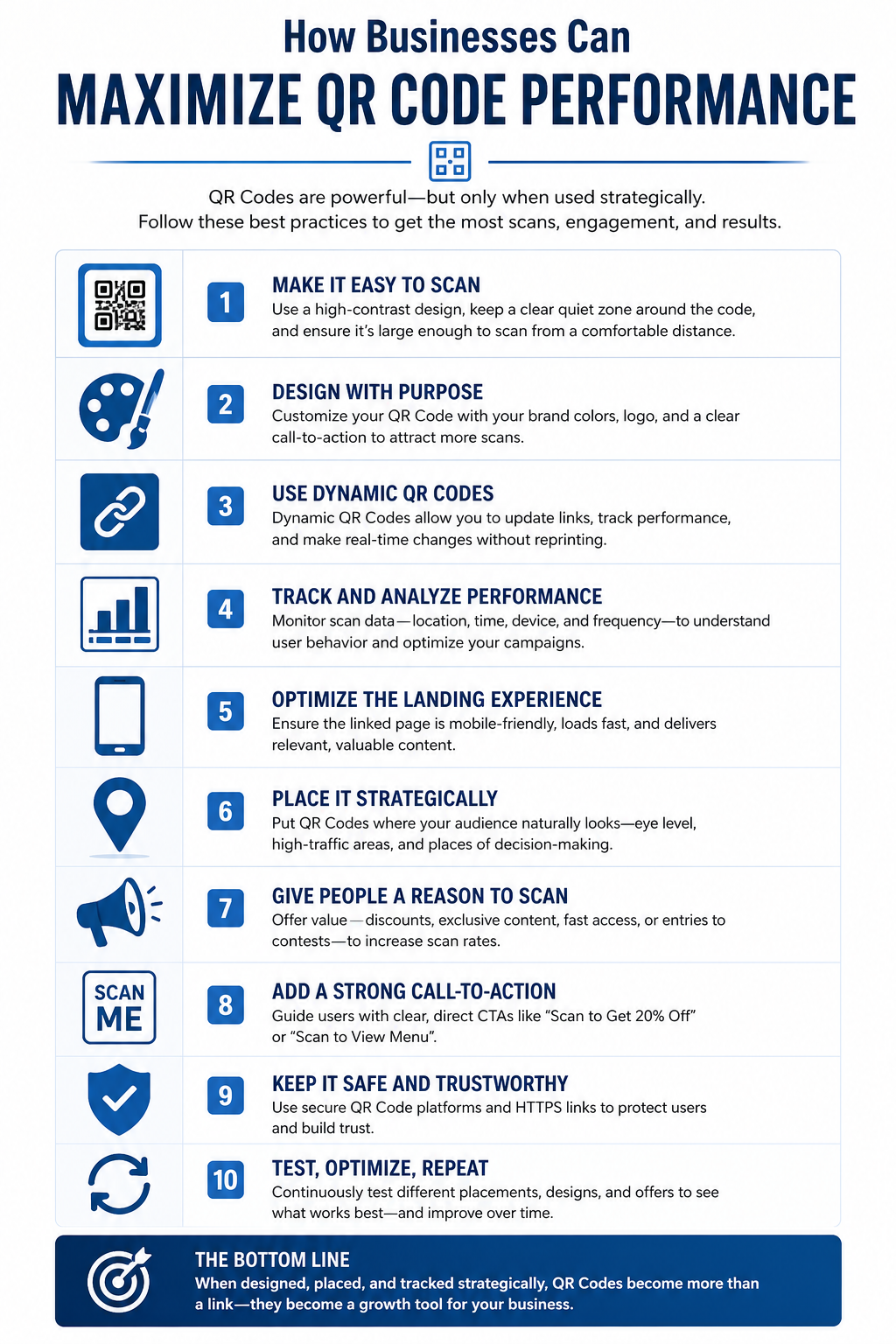
How Businesses Can Maximize QR Code Performance
Creating a QR Code is only the first step. To achieve the best results, businesses should develop a clear strategy for where and how the QR Code will be used. A well-planned QR Code campaign can increase customer engagement, improve brand awareness, and generate valuable business insights.
Before creating a QR Code, identify its purpose. Ask yourself what action you want users to take after scanning. This could include visiting a website, downloading an app, making a purchase, subscribing to a newsletter, or following your social media accounts.
Placing QR Codes in highly visible locations significantly improves scan rates. They should be positioned where users have enough time and space to scan comfortably. For example, QR Codes on product packaging should be large enough to scan easily, while QR Codes on billboards should be much larger because they are viewed from a distance.
QR Codes for Small Businesses
Small businesses often have limited marketing budgets. QR Codes provide an affordable way to reach customers without spending heavily on advertising.
Small businesses can use QR Codes to:
- Share digital business cards
- Display Google Maps directions
- Collect customer reviews
- Promote seasonal discounts
- Link to online stores
- Offer digital coupons
- Provide customer support information
Even a simple QR Code on a business card can make networking easier by allowing contacts to save information instantly.
QR Codes in Real Estate
Real estate professionals increasingly use QR Codes to simplify property marketing.
A QR Code on a property sign can direct potential buyers to:
- Property photos
- Virtual tours
- Video walkthroughs
- Floor plans
- Agent contact information
- Mortgage calculators
- Appointment booking pages
This allows buyers to access detailed information without needing printed brochures.
QR Codes in Manufacturing
Manufacturers use QR Codes to improve product tracking and quality control.
Applications include:
- Inventory management
- Product identification
- Equipment maintenance records
- Assembly instructions
- Quality assurance documentation
- Supply chain tracking
Employees can scan QR Codes to retrieve important information instantly, improving productivity and reducing errors.
QR Codes for Customer Support
Many companies now include QR Codes on products to provide instant customer support.
Customers can scan a QR Code to:
- Download user manuals
- Watch setup videos
- Contact customer service
- Register products
- Access warranty information
- Submit support requests
This reduces support costs while improving the customer experience.
Measuring QR Code Success
Businesses should evaluate the performance of their QR Code campaigns regularly.
Some useful performance indicators include:
- Total number of scans
- Unique visitors
- Geographic locations
- Device types
- Time of scans
- Conversion rate
- Customer engagement
- Return on investment (ROI)
Analyzing these metrics helps businesses improve future campaigns and better understand customer behavior.
Common Myths About QR Codes
There are several misconceptions about QR Codes.
Myth 1: QR Codes are outdated. Reality: QR Codes continue to grow in popularity worldwide and are widely used for payments, marketing, education, and customer engagement.
Myth 2: QR Codes only work with special apps. Reality: Most modern smartphones can scan QR Codes directly using the built-in camera.
Myth 3: QR Codes are only useful for large companies. Reality: Businesses of every size can benefit from QR Codes, from local shops to international brands.
Myth 4: QR Codes are expensive. Reality: Static QR Codes can often be created for free, while advanced dynamic QR Codes are available at reasonable prices.
Why QR Codes Continue to Grow
Several factors contribute to the increasing popularity of QR Codes:
- Widespread smartphone usage
- Faster mobile internet
- Growth of contactless payments
- Expansion of online shopping
- Digital transformation of businesses
- Demand for paperless communication
- Improved customer convenience
These trends suggest that QR Codes will remain an important technology for many years.
Conclusion
QR Codes have transformed the way people access and share digital information. Their versatility allows them to be used in marketing, education, healthcare, retail, manufacturing, real estate, tourism, and countless other industries.
Whether you are a business owner looking to engage customers, a teacher sharing educational resources, or an individual wanting to exchange information quickly, QR Codes provide a fast, reliable, and user-friendly solution.
By following best practices, maintaining security, and using QR Codes strategically, you can enhance communication, improve customer experiences, and support long-term digital growth. As technology continues to evolve, QR Codes are expected to remain one of the simplest and most effective tools for connecting the physical and digital worlds.